
If you’re still measuring Instagram success mainly by likes, you’re reading the wrong scoreboard. The Instagram algorithm has quietly rewritten many of the rules of content marketing, and brands that haven’t noticed the shift are often left wondering why their seemingly “high-performing” posts aren’t turning into meaningful business results.
I’ve spent the last year watching this shift play out across client accounts, and the pattern is becoming difficult to ignore. Likes still appear on the analytics dashboard, but they don’t always tell the full story anymore. What increasingly moves the needle under the Instagram algorithm are stronger signals of interest and value, including watch time, saves, and shares.
This isn’t just a small adjustment to the way brands should look at their analytics. It’s a bigger change in what “good content” means on the platform. The Instagram algorithm is encouraging marketers to think beyond quick reactions and focus more on whether people genuinely spend time with content and find it useful enough to return to or share with others.
For content marketers, this means the goal is no longer simply to publish something attractive and collect likes. Content needs to earn attention and provide a reason for people to take a meaningful action. Understanding this change is becoming an important part of building a sustainable Instagram content strategy.
Table of Contents
The Shift: From Likes to Meaningful Actions
For years, the metric that mattered most on Instagram was simple: how many people tapped the heart. A post with a lot of likes looked successful, got shared internally as a win, and was often repeated in slightly different forms the following month.
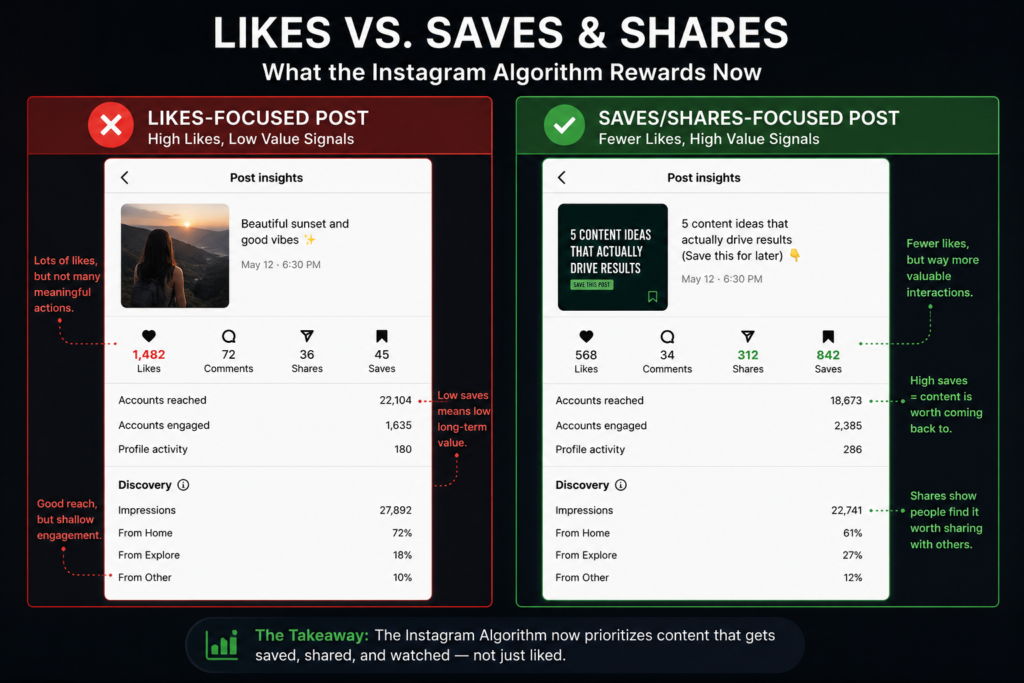
That’s no longer the complete picture of how the Instagram algorithm evaluates content. The platform places greater importance on meaningful actions and stronger engagement signals, particularly watch time, saves, and shares. A like takes only a fraction of a second and costs the viewer very little. A save suggests that someone found the content valuable enough to want it again later. A share can mean they found it useful, interesting, or relevant enough to send to another person.
That distinction changes everything about content strategy. The question is no longer simply, “How do we get more engagement?” A better question is, “How do we create something valuable enough that people want to watch, keep, or hand to a friend?” This way of thinking is much more aligned with how the Instagram algorithm increasingly evaluates content quality.
There’s another part of this shift that doesn’t get talked about enough: original, platform-specific content is becoming increasingly important. Content that is clearly recycled from somewhere else — a TikTok with the watermark barely cropped out, for example, or a graphic that looks like it was designed for a blog and simply dropped onto a Reel — can feel less natural to the Instagram audience.
Content created specifically for the platform usually considers how people actually consume posts, Reels, Stories, and carousels on Instagram. The Instagram algorithm is closely connected to audience behavior, so planning for the platform itself matters just as much as the message. This is one reason why platform-native content has become an important part of a strong Instagram strategy.
Instead of asking whether a piece of content can be posted everywhere without changes, brands should ask whether it makes sense specifically for Instagram. Small changes in formatting, pacing, visuals, captions, and hooks can make a significant difference in how the audience responds and how the Instagram algorithm interprets that response.
A Real Example: When Fewer Likes Meant Better Results
Here’s a case that illustrates the point clearly. One piece of content was built around giving genuinely practical and useful information. There was nothing especially flashy about it and no attempt to chase every trend. Instead, it focused on sharing something worth knowing.
The content was designed to encourage people to slow down, actually read it, and save it for later rather than simply double-tap and scroll past. That difference in intention changed how the post was created from the beginning.
The result wasn’t a huge number of likes. However, the saves and shares were strong — noticeably stronger than posts from the same account that had chased likes directly with more traditionally “engaging” formats and hooks.
That result reframed how I think about performance under the Instagram algorithm. A post doesn’t need a massive like count to provide real value or perform well. In some situations, chasing likes and chasing saves can even pull content in different directions.
Content designed purely to get an immediate reaction may succeed at earning a quick like but fail to give people anything worth returning to. Content built to genuinely help someone may receive fewer instant reactions while earning more saves and shares over time. These stronger actions can provide a clearer indication that the audience found the content genuinely useful.
This is why looking only at likes can sometimes create the wrong impression. A post with fewer likes might still be one of the most valuable pieces of content on an account if people are saving and sharing it. When reviewing performance, the Instagram algorithm should not be viewed through a single metric. The complete pattern of audience behavior matters more.
The lesson from this example was simple: don’t automatically assume that the post with the most visible engagement is the best-performing piece of content. Sometimes the quieter metrics tell the more important story.
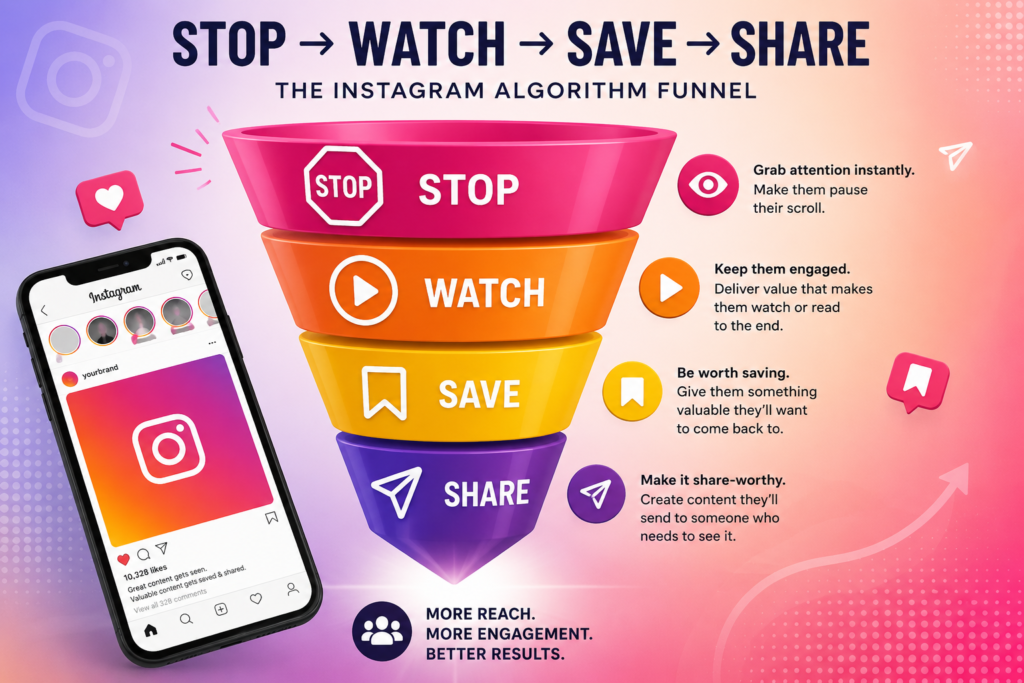
The Framework: Stop → Watch → Save → Share
Once you understand what the Instagram algorithm is rewarding, you need a simple way to plan content around those behaviors. Here’s the framework that’s worked well for planning content:
1. Stop. What’s going to make someone pause their scroll for this specific post? This could be a strong opening line, a bold visual, a surprising statement, or a question that speaks directly to something your audience is dealing with. If nothing earns the stop, nothing else has the opportunity to happen.
2. Watch. Once you’ve got their attention, does the content give them a reason to keep watching or reading until the end? This is where a lot of content quietly fails. It hooks people successfully and then runs out of substance halfway through.
3. Save. Is there something in this post worth saving for later — a tip, a checklist, a reference, an idea, or a process? If someone wouldn’t have a reason to look at this content again next week, it’s probably less likely to earn a save.
4. Share. Would someone send this to a specific person they know? Not simply “share because it’s nice,” but share because it solves a problem, explains something useful, or reminds them of someone who could benefit from seeing it.
This framework works because it focuses on real audience behavior rather than guesswork. Each stage represents an action that can help marketers understand whether a piece of content is genuinely connecting with people. Instead of asking what might randomly perform well, you’re planning around the behaviors that matter to the Instagram algorithm.
How the Framework Changes Content Planning
| Old Approach | Stop-Watch-Save-Share Approach |
|---|---|
| “What should we post today?” | “Why would someone stop, watch, save, and share this?” |
| Success measured mainly in likes | Success measured through saves, shares, and watch time |
| Consistency for its own sake | Consistency in delivering real value |
| Content designed mainly to look polished | Content designed to be useful enough to revisit |
| React to trends as they happen | Understand the audience and adapt based on results |
The difference between these approaches may look small, but it changes the entire planning process. The old approach often begins with the pressure to publish. The newer approach begins with the audience.
Before creating a post, ask what specific value it provides. What problem does it solve? What question does it answer? Why should someone spend time with it? These questions can help make content more useful and better aligned with the behaviors the Instagram algorithm is looking for.
The Mistake Most Brands Are Still Making
Even with this shift becoming increasingly clear, one mistake continues to appear across brand accounts: posting consistently without asking whether each individual post gives someone a reason to stay, save, or share it.
A polished design and a catchy caption aren’t enough on their own anymore. Plenty of brands are technically “doing everything right” — maintaining a regular posting schedule, using on-brand visuals, and writing decent captions — while still seeing engagement flatten out.
The problem usually isn’t a lack of effort. It’s that the content isn’t built around a real reason for someone to act on it.
The fix is a small but important shift in the planning question. Instead of starting with, “What should we post today?” start with, “Why would someone stop, watch this, save it, or share it with someone else?”
That single reframe can change what gets approved before content is even produced. It encourages teams to think about audience value earlier instead of trying to optimize a weak idea after it has already been created.
The Instagram algorithm cannot turn every ordinary post into a high-performing one. Strong performance usually begins with a strong reason for the content to exist. Better planning often matters more than trying to fix everything later through hashtags, posting times, or small caption changes.
Common Mistakes to Avoid
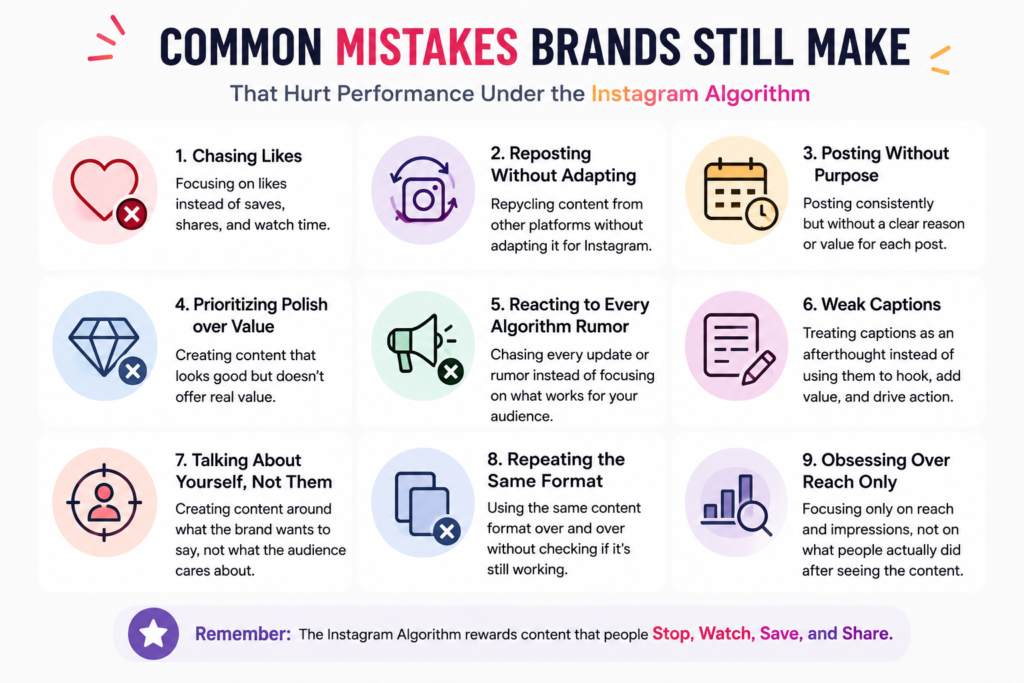
- Chasing likes instead of paying attention to saves, shares, and watch time.
- Recycling content from other platforms without properly adapting it for Instagram.
- Posting on a schedule without a clear reason for each post to exist.
- Prioritizing polish over practical value.
- Reacting to every Instagram algorithm rumor instead of watching your own account’s data.
- Treating captions as an afterthought instead of part of the hook.
- Creating content around what the brand wants to say instead of what the audience actually wants to know.
- Repeating the same content format without checking whether it still works.
- Looking at reach without considering what people actually did after seeing the content.
Avoiding these mistakes doesn’t mean every post will perform perfectly. The Instagram algorithm is influenced by multiple factors, and audience behavior can change. However, these adjustments can create a stronger foundation for consistent improvement.
What This Means for Your Content Strategy Going Forward
Chasing every small update to the Instagram algorithm is a losing game. By the time you’ve adjusted to one change, the platform may already be testing something else or audience behavior may have shifted again.
A more durable approach is to focus on understanding your audience and consistently creating content that provides genuine value.
The Instagram algorithm will continue to evolve. That part is almost guaranteed. What doesn’t change as quickly is the basic reason people engage with content. People spend time with posts that are useful, interesting, entertaining, relevant, or worth sharing.
Brands that experiment with different formats, pay close attention to what their specific audience responds to, and adapt based on actual performance data will be in a better position to respond to future changes.
The goal should not be to “beat” the Instagram algorithm. Instead, the goal is to create content that people genuinely want to watch, save, and share. When content provides that kind of value, the audience behavior naturally becomes stronger.
A good strategy is also flexible. Don’t assume that one successful Reel or carousel provides a permanent formula. Look for patterns across multiple posts and continue testing. The Instagram algorithm may change, but regular learning from your own audience data will remain valuable.
Measuring What Actually Matters Now
If you’re still building your weekly report around likes and reach alone, you’re probably not measuring the complete picture of what the Instagram algorithm values.
It’s worth rebuilding your reporting template around three important numbers: saves, shares, and average watch time for video content. These metrics can tell you far more about whether a post is genuinely working than likes alone.
A practical way to begin is to pull the last 20–30 posts from an account and sort them by saves and shares instead of likes or reach.
In many accounts, the ranking changes noticeably. Posts that looked mediocre based on like count can rise to the top when sorted by saves. At the same time, posts that originally looked like obvious wins because they received many likes can fall toward the bottom.
That reordering can be one of the fastest ways to show a team that the old scoreboard was incomplete. Looking beyond visible engagement helps reveal which content is actually useful enough for people to take stronger actions.
Once you know which posts are earning saves and shares, look for what they have in common.
Is it a particular format? Carousels, for example, can naturally encourage saves because they often work like mini-reference guides.
Is it a specific topic? Practical, educational, and tip-based content may earn saves more consistently than purely promotional announcements.
Is it related to pacing? In Reels, a clear structure and useful payoff may keep people watching longer than a fast trend with little substance.
Patterns taken from your own account are often more useful than blindly following generic advice. Every audience behaves differently, and your analytics can show what the Instagram algorithm is rewarding for your particular content and audience.
Applying the Framework to Different Content Formats
The Stop-Watch-Save-Share framework can work across different formats, but each format requires slightly different execution.
Reels. The “stop” needs to happen quickly because viewers can scroll away almost immediately. A strong opening can create curiosity, identify a problem, or promise a useful result. From there, the content needs to maintain interest through the middle rather than giving everything away instantly. A clear payoff can increase the chances that someone watches longer, saves the Reel, or shares it with another person.
When planning Reels for the Instagram algorithm, don’t focus only on the first hook. The middle and ending matter too. A strong beginning followed by weak content may attract attention without keeping it.
Carousels. Carousels are naturally suited to the “save” stage because they can work like a small reference document. The first slide needs to handle the “stop” by making a clear promise about what the reader will learn. Each following slide should continue delivering useful information without unnecessary padding.
Carousels that feel genuinely useful and easy to revisit can perform strongly because people may save them for later. The Instagram algorithm can benefit from the stronger audience signals created when content continues providing value beyond the first interaction.
Static posts and single images. These formats have less opportunity to build watch time, so the visual’s immediate clarity and the caption become especially important. A strong static post often combines a specific, useful claim in the image with a caption that expands on the idea enough to make the content worth reading and saving.
Regardless of the format, the underlying question remains the same: does this specific piece of content give someone a real reason to stop, keep watching, save it, or share it?
Formats change the execution, but the core audience behavior behind the Instagram algorithm remains an important part of the strategy.
Building a Better Content Planning Process
A useful planning process doesn’t have to be complicated. Before publishing a piece of content, review it using the Stop-Watch-Save-Share framework.
Start by identifying the audience problem or interest behind the post. Then ask whether the opening is strong enough to make someone stop scrolling. After that, review whether the rest of the content gives them enough value to continue.
Finally, ask what action the content is most likely to encourage. Not every post needs to do everything equally well. Some may be particularly strong for watch time, while others may naturally encourage saves or shares.
The important thing is that the action is intentional.
This approach also makes content reviews easier. Instead of saying that a post “looks good,” you can ask whether it has a clear purpose. That creates more useful conversations about strategy and can help teams make better decisions before publishing.
A content calendar should also leave room for learning. Use previous performance to guide future ideas. If practical carousel posts consistently earn saves, explore similar topics. If certain Reel structures keep viewers watching longer, test variations rather than assuming the result was accidental.
Over time, this creates a feedback loop between audience behavior, content planning, and the Instagram algorithm.
Frequently Asked Questions
Does the Instagram algorithm still consider likes at all?
Likes are still a form of engagement, but they should not be the only metric used to judge performance. Watch time, saves, shares, and other audience behaviors can provide a deeper understanding of how people respond to content.
How can I tell if my content is “save-worthy”?
Ask whether someone would have a reason to look at it again next week. Tips, processes, checklists, references, and useful explanations are more likely to encourage saves than content with nothing to return to.
Is repurposed content from other platforms still worth posting on Instagram?
It can still work, but it should be adapted properly. Content created or adjusted specifically for Instagram, with suitable formatting and a hook designed for how people use the platform, can feel more natural to the audience.
How often should I post to keep up with the Instagram algorithm?
Posting frequency matters, but quality and audience value should not be sacrificed simply to maintain a schedule. A smaller number of genuinely useful posts can be more valuable than frequent content with no clear reason for someone to save or share it.
Will understanding the Instagram algorithm guarantee more reach?
No strategy can guarantee reach. The Instagram algorithm considers multiple signals, and performance can vary. However, creating content that encourages meaningful audience actions gives you a stronger foundation than focusing only on visible engagement.
Should every post be designed to go viral?
No. Viral reach can be useful, but it should not be the only goal. A smaller post that reaches the right audience and earns saves, shares, enquiries, or meaningful engagement may be more valuable to a business than a viral post with little long-term impact.
Key Takeaways
- The Instagram algorithm increasingly places importance on meaningful audience actions such as watch time, saves, and shares.
- Likes still matter as engagement, but they do not always tell the complete performance story.
- Original, platform-specific content can provide a better experience for the Instagram audience than content that is simply recycled without adaptation.
- The Stop-Watch-Save-Share framework gives you a practical way to plan content around real audience behavior.
- The most common mistake brands make is posting consistently without giving each post a clear reason to earn attention, saves, or shares.
- Measuring saves, shares, and watch time can provide a clearer understanding of what is actually working.
- Different formats require different execution, but the underlying principle remains the same.
- Reels need strong retention, carousels can be highly save-worthy, and static posts need immediate clarity and useful captions.
- The best long-term strategy is not chasing every Instagram algorithm update but learning from your own audience and adapting based on real results.
- The goal is not to beat the Instagram algorithm. The goal is to create content people genuinely want to stop for, watch, save, and share.
Ultimately, successful Instagram content starts with understanding people. The Instagram algorithm will continue to change, but useful and relevant content will always have a stronger chance of creating meaningful audience behavior.
Instead of asking how to trick or beat the system, focus on creating something worth someone’s time. If a person stops scrolling, stays interested, saves the information, or shares it with someone else, the content has already achieved something far more valuable than simply collecting another like.
That is the mindset that can help brands build a stronger, more sustainable content strategy as the Instagram algorithm continues to evolve.
Understanding the Instagram algorithm is an important part of building a successful content strategy. From creating content people want to save and share to improving audience engagement, a strong strategy can make a real difference. As a Freelance Digital Marketer in Malappuram, I help businesses build effective digital marketing strategies that focus on real results and meaningful online growth.